
Waste air heat exchanger: EST energy spray tunnel
For waste air containing sticky, greasy or tar-like condensing substances: the spray tunnel uses water to extract the heat and scrub the air at the same time.
Waste air with sticky or tar-like condensing substances is no longer suitable for exhaust gas heat exchangers. That is what the filterless EST energy spray tunnel is for: water extracts the heat and scrubs the air at the same time.
How the spray tunnel works
- Hot waste air flows through the tunnel and is sprayed with fine water droplets.
- The water absorbs the heat and washes out dirt particles. Most of the oils and fats bind to the water as droplets or an oil film.
- A FERCHER FB wastewater heat exchanger transfers the heat to clean service water.
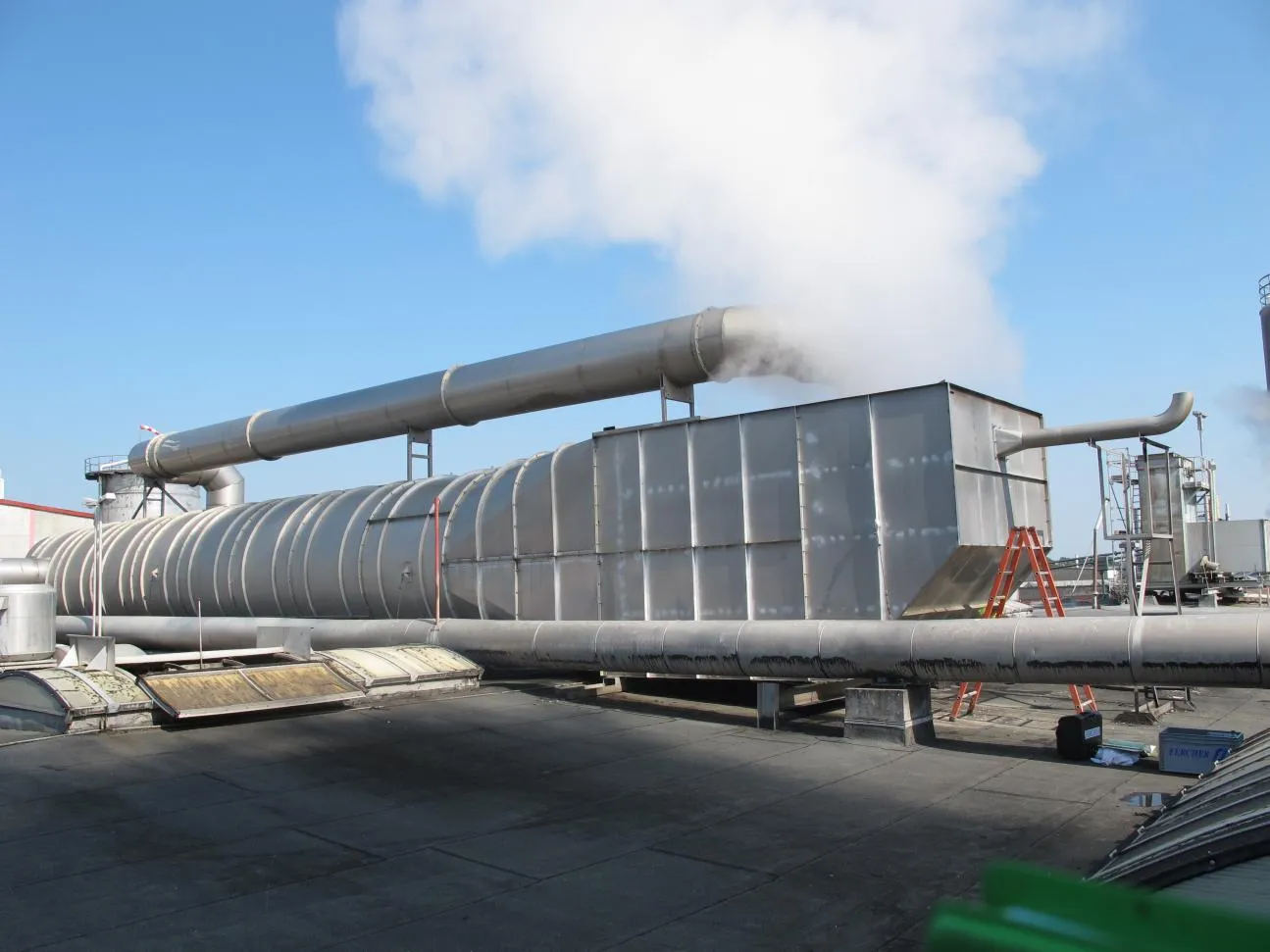
Three effects in one unit
- Heat: the energy flows back into your plant through the heat exchanger.
- Clean air: suspended matter is washed out. Depending on the substance, odours drop too, because even substances that are not water-soluble can condense as the air cools.
- Water: steam in the waste air condenses, and this water can go back into production.
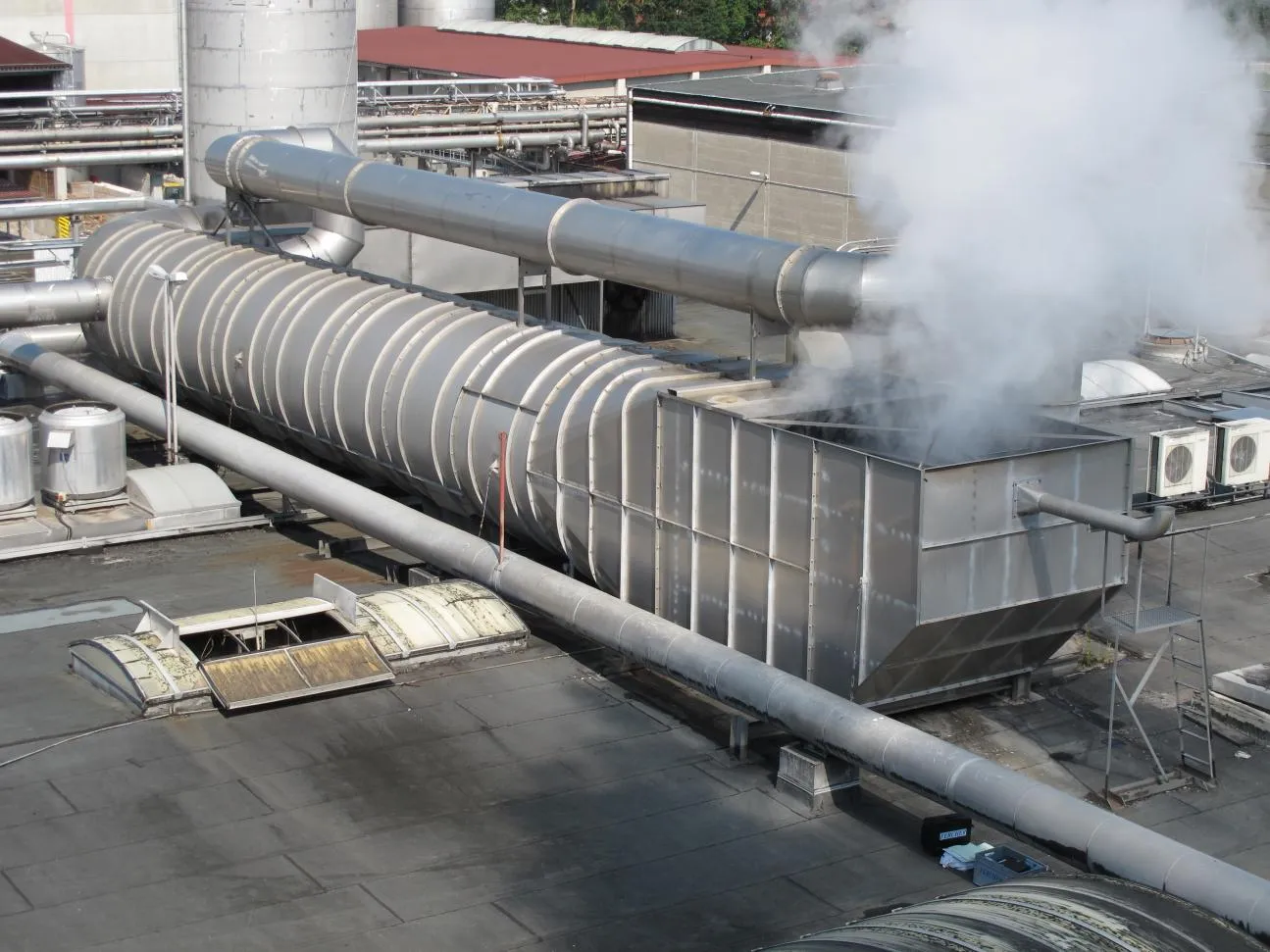
Test it first
For special cases with difficult odours we provide a test spray tunnel under a separate written agreement, so you can carry out your own measurements. As the operator you handle installation, connection, operation and return transport. Conditions on request at office@fercher.at.
The unit runs on a partial flow of your actual waste air. At a paper mill it cooled the waste air from 84.5 °C to 31.3 °C. From such measurements we scale up to the full system before you invest. The scaled-up figures are planning values for the measured operating conditions.
Type overview
| Type | Length | Max. waste air | Spray nozzles | Spray water | Empty weight |
|---|---|---|---|---|---|
| EST-300-X2 | 3,015 mm | 300 Bm³/h | 4 | 0.4 L/s | 90 kg |
| EST-300-X3 | 4,020 mm | 400 Bm³/h | 6 | 0.6 L/s | 118 kg |
| EST-300-X4 | 5,025 mm | 500 Bm³/h | 8 | 0.8 L/s | 147 kg |
| EST-D-1200-X2 | 6,500 mm | 10,000 Bm³/h | 24 | 2.4 L/s | 720 kg |
| EST-D-1200-X3 | 8,500 mm | 14,000 Bm³/h | 36 | 3.6 L/s | 940 kg |
| EST-D-1200-X4 | 10,500 mm | 16,500 Bm³/h | 48 | 4.8 L/s | 1,160 kg |
| EST-D-1400-X1 | 4,581 mm | 6,000 Bm³/h | 18 | 1.8 L/s | 650 kg |
| EST-D-1400-X2 | 6,691 mm | 12,000 Bm³/h | 36 | 3.6 L/s | 936 kg |
| EST-D-1400-X3 | 8,701 mm | 18,000 Bm³/h | 54 | 5.4 L/s | 1,222 kg |
| EST-D-1400-X4 | 10,711 mm | 24,000 Bm³/h | 72 | 7.2 L/s | 1,508 kg |
| EST-D-1800-X2 | 9,300 mm | 32,000 Bm³/h | 60 | 6.0 L/s | 1,420 kg |
| EST-D-1800-X3 | 12,300 mm | 43,000 Bm³/h | 90 | 9.0 L/s | 1,870 kg |
| EST-D-1800-X4 | 15,300 mm | 54,000 Bm³/h | 120 | 12.0 L/s | 2,320 kg |
| EST-D-2500-X2 | 10,330 mm | – | 120 | – | 3,800 kg |
| EST-D-2500-X3 | 13,340 mm | – | 180 | – | 5,000 kg |
| EST-D-2500-X4 | 16,350 mm | – | 240 | – | 6,200 kg |
| EST-D-4000-15 | 15,000 mm | 200,000 Bm³/h | 300 | 30.0 L/s | 10,560 kg |
Used in these industries
Frequently asked questions
What kind of waste air is the spray tunnel suitable for?
For waste air with sticky, greasy or tar-like condensing substances, where exhaust gas heat exchangers are no longer suitable. Typical examples are steam peelers, fryers, ironers and dryer sections.
How is the heat in the spray water used?
The spray water is contaminated by the substances washed out. It therefore runs over a FERCHER FB wastewater heat exchanger, which transfers the heat to clean service water.
Does the spray tunnel also clean the waste air?
Yes. Macroscopic solids such as dust or lint are largely washed out. Depending on the odorous substance, odours are reduced as well.
Can I test the spray tunnel first?
Yes. For special cases with difficult odours we provide a test spray tunnel under a separate agreement, so you can carry out your own measurements. Conditions on request.
Who looks after the spray water?
Hygiene including protection against legionella, blow-down and disposal of the spray water are within the operator's area of responsibility.